
WHO BOHO HELPS

Build around the way your customers actually decide.

Contractors need qualified estimate requests. Local service businesses need calls and bookings. Physical locations need visits and reservations. Online stores need product discovery and completed purchases. Professional firms need serious, well-qualified conversations.

Boho studies the path to that action, identifies where the current digital system loses people, and recommends the smallest complete scope that can improve it.

Owner-operated · Research-led · Public starting prices · Documented decisions · Ownership defined in writing

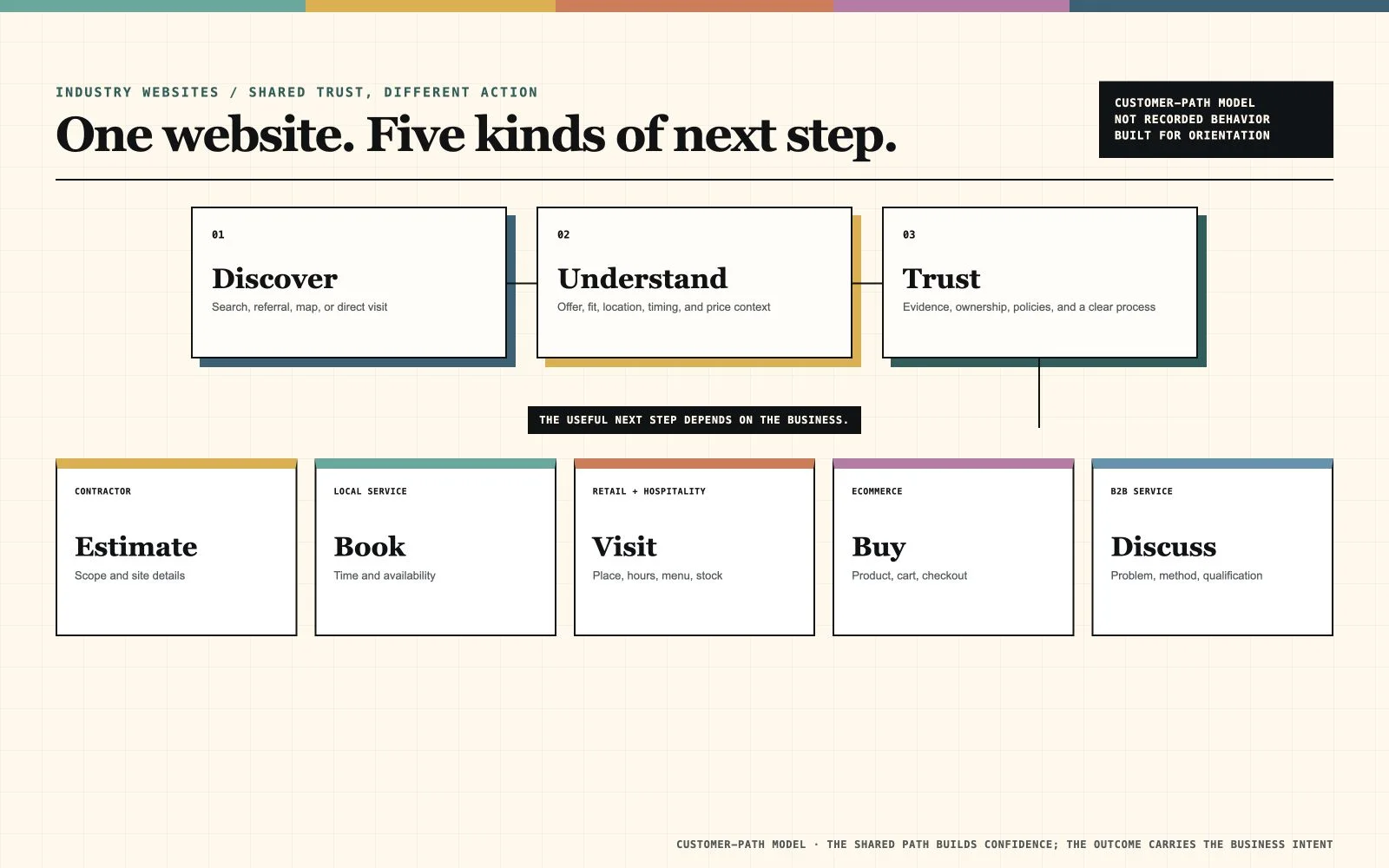
One shared decision path

  1. DiscoverBe found
  2. UnderstandRecognise fit
  3. TrustReduce doubt

The useful action changes with the business.

  • EstimateProject work
  • BookLocal services
  • VisitPhysical locations
  • BuyOnline stores
  • DiscussProfessional firms

Customers usually need to find the business, recognise fit, and build trust. What happens next depends on how the business creates value.

Figure 01 · Decision summaryThree shared decision stages and five distinct customer actions.Boho-owned semantic decision summary.Concept model, not a measured customer journey or client result.

BUSINESS-MODEL COMPARISON

The technology may overlap. The decision does not.

Scroll horizontally to compare every column.

Customer pathCustomer needs to knowTrust usually comes fromValuable action
EstimateCan this company handle the right project?Project proof, process, area, verified credentialsEstimate, inspection, consultation
BookIs the service suitable, available, and convenient?Team, reviews, policies, fit, locationCall, booking, request, visit
VisitIs it worth making the trip?Current information, experience, reputationDirections, reservation, event, pickup
BuyIs this the right product and safe to purchase?Product clarity, usability, policies, proofCart, checkout, purchase
DiscussDoes this expertise fit the problem?Positioning, people, method, evidenceQualified inquiry or proposal request

HIGH-VALUE PROJECT BUSINESSES

High-value project work needs qualified inquiries, not decorative traffic.

Your best projects are valuable. The website should not treat every visitor, service, and inquiry as though they are equal.

Contractors, remodelers, restoration firms, specialty trades, and related project businesses need to help the right prospect recognise the service, confirm the location and project fit, inspect credible proof, and request the correct estimate or consultation.

An electrician working inside a residential renovation project
Figure 02 · Context photographRepresentative setting for estimate a project decisions.Licensed Pexels editorial photograph; source recorded in the asset register.Representative setting · Not client work · No measured result.
  1. 01Project need
  2. 02Service and location fit
  3. 03Process and project proof
  4. 04Estimate or inspection
Figure 03 · Customer-decision pathA readable sequence leading toward estimate a project.Boho-owned explanatory diagram.Starting hypothesis; actual paths must be inspected.

Common leaks

  • Broad service descriptions that do not reflect actual project types
  • Unclear service areas
  • Project galleries without context
  • Weak mobile estimate paths
  • Forms that fail to qualify service, location, timing, or project type
  • Planned and urgent work mixed together
  • Poor lead-source visibility
  • Unclear provider or account ownership

What Boho would inspect

  1. 01High-value service structure
  2. 02Service-area logic
  3. 03Project-proof quality
  4. 04Estimate and telephone paths
  5. 05Mobile usability
  6. 06Search and local presence
  7. 07Lead measurement
  8. 08Domain, hosting, analytics, and provider control

BEST STARTING ROUTES

Begin with the smallest useful next step.

The initial review is free and uses public information to identify the next useful discussion. It is not a complete audit, written strategy, private-account review, or implementation engagement.

APPOINTMENT AND LOCAL SERVICES

Make the service easy to understand, trust, and book.

Customers can choose a nearby provider in less time than it takes to understand a confusing service page.

Local service businesses must quickly communicate service fit, location or service area, availability, people, policies, trust, and the correct action.

Appointment-based

Clinics, salons, wellness providers, tutors, fitness businesses, and pet care

Service-area

Cleaning, repair, mobile services, home visits, and on-location work

Location-based or recurring

Studios, membership businesses, repeat-service providers, and local organisations

  1. 01Local discovery
  2. 02Service fit
  3. 03Trust, location, and availability
  4. 04Call, book, visit, or request
Figure 04 · Customer-decision pathA readable sequence leading toward book or request service.Boho-owned explanatory diagram.Starting hypothesis; actual paths must be inspected.
OBSERVATION RECORDLOCAL-SERVICE
QuestionIs the service suitable, available, and convenient?
  1. 01Website
  2. 02Public profile
  3. 03Booking
  4. 04Location
Useful actionCall, booking, request, visit
Figure 05 · Concept interfacePublic-information consistency map. A concept check connecting the website, public profile, booking route, calls, and location information.Boho-owned explanatory concept.Concept · Not client work · No measured result.

Common leaks

  • Inconsistent business information
  • Vague service fit
  • Weak practitioner or team information
  • Booking friction
  • Poor mobile call paths
  • Missing confirmation expectations
  • Privacy-sensitive forms collecting too much
  • Calls and bookings not measured consistently

What Boho would inspect

  1. 01Service and audience clarity
  2. 02Website and public-profile consistency
  3. 03Booking and contact systems
  4. 04Team and trust information
  5. 05Service-area representation
  6. 06Review context
  7. 07Measurement quality
  8. 08Regulated-claim and privacy boundaries

BEST STARTING ROUTES

Begin with the smallest useful next step.

Do not send health, patient, or other sensitive personal data through the intake form. Regulated public claims require appropriate client-supplied review.

The initial review is free and uses public information to identify the next useful discussion. It is not a complete audit, written strategy, private-account review, or implementation engagement.

RETAIL, HOSPITALITY, FOOD, AND VENUES

Turn discovery into a confident visit, reservation, event, or pickup.

Customers should not need three platforms to determine whether you are open, available, accessible, or worth the trip.

Physical businesses must keep hours, directions, accessibility, parking, menus, products, events, reservations, pickup, and seasonal information current across the customer’s decision path.

Local retail and showrooms

Products, pickup, visits, and in-person advice

Food, drink, and reservations

Menus, current hours, availability, and booking

Venues, galleries, and events

Schedules, access, registration, and arrival planning

Hospitality and destinations

Fit, availability, travel decisions, and current information

  1. 01Discover
  2. 02Check current information
  3. 03Decide whether the visit fits
  4. 04Reserve, register, visit, or pick up
Figure 06 · Customer-decision pathA readable sequence leading toward visit or reserve.Boho-owned explanatory diagram.Starting hypothesis; actual paths must be inspected.
OBSERVATION RECORDRETAIL-HOSPITALITY
QuestionIs it worth making the trip?
  1. 01Before leaving
  2. 02In transit
  3. 03Arrival
  4. 04Follow-up
Useful actionDirections, reservation, event, pickup
Figure 07 · Concept interfaceVisit-decision timeline. A concept sequence for checking current information before leaving, in transit, on arrival, and after a visit.Boho-owned explanatory concept.Concept · Not client work · No measured result.

Common leaks

  • Conflicting hours
  • Stale menus, products, or events
  • Poor mobile navigation
  • Missing parking or accessibility information
  • Complicated reservation paths
  • Weak location pages
  • Unclear pickup or ordering
  • Seasonal changes not reflected consistently

What Boho would inspect

  1. 01Website and profile consistency
  2. 02Location information
  3. 03Menu, product, and event structure
  4. 04Mobile arrival planning
  5. 05Reservation and order paths
  6. 06Directions and accessibility
  7. 07Local search presentation
  8. 08Measurement of visits and reservations where reasonably available

The initial review is free and uses public information to identify the next useful discussion. It is not a complete audit, written strategy, private-account review, or implementation engagement.

ECOMMERCE AND PRODUCT BUSINESSES

Help the right product get found, understood, trusted, and purchased.

Good products cannot compensate for a catalog customers and search systems struggle to understand.

Ecommerce work should connect category structure, product information, internal discovery, technical health, customer trust, checkout, and reliable measurement.

  1. 01Category or product discovery
  2. 02Comparison
  3. 03Product, availability, and policy clarity
  4. 04Cart, checkout, and purchase
Figure 08 · Customer-decision pathA readable sequence leading toward buy a product.Boho-owned explanatory diagram.Starting hypothesis; actual paths must be inspected.
OBSERVATION RECORDECOMMERCE
QuestionIs this the right product and safe to purchase?
  1. 01Customer need
  2. 02Category
  3. 03Product
  4. 04Policy
Useful actionCart, checkout, purchase
Figure 09 · Concept interfaceCatalog relationship map. A concept map showing how customer language, categories, products, variants, and policies support discovery and comparison.Boho-owned explanatory concept.Concept · Not client work · No measured result.

Common leaks

  • Categories reflecting internal inventory rather than customer intent
  • Important products buried in navigation
  • Incomplete product decision information
  • Duplicate or confusing variant URLs
  • Unclear shipping, returns, or availability
  • Checkout friction
  • Broken or conflicting analytics
  • Repeated manual catalog work

What Boho would inspect

  1. 01Catalog architecture
  2. 02Category and product discovery
  3. 03Product-page information
  4. 04Internal links and navigation
  5. 05Technical access and duplicate handling
  6. 06Policies and trust
  7. 07Cart and checkout signals
  8. 08Data quality and platform disagreement

BEST STARTING ROUTES

Begin with the smallest useful next step.

Ecommerce does not qualify for the informational-website minimum. Builds, checkout systems, account functions, large migrations, and payment-enabled projects receive a specific quote.

The initial review is free and uses public information to identify the next useful discussion. It is not a complete audit, written strategy, private-account review, or implementation engagement.

PROFESSIONAL AND B2B SERVICES

Make the expertise clear enough for the right buyer to continue.

Serious expertise should not be hidden behind vague “solutions” language and an unqualified contact form.

Professional and B2B buyers may need to understand the problem, fit, people, method, proof, risk, process, and next step before beginning a conversation.

  1. 01Referral or search
  2. 02Service and problem fit
  3. 03People, method, and evidence
  4. 04Qualified conversation or proposal request
Figure 10 · Customer-decision pathA readable sequence leading toward start a qualified conversation.Boho-owned explanatory diagram.Starting hypothesis; actual paths must be inspected.
OBSERVATION RECORDPROFESSIONAL-B2B
QuestionDoes this expertise fit the problem?
  1. 01Buyer question
  2. 02People
  3. 03Method
  4. 04Evidence
Useful actionQualified inquiry or proposal request
Figure 11 · Concept interfaceBuyer and proof architecture. A concept map connecting buyer questions, responsible people, the working method, evidence, and the qualified next step.Boho-owned explanatory concept.Concept · Not client work · No measured result.

Common leaks

  • Vague positioning
  • Services organised around internal terminology
  • Unsupported authority claims
  • Thin educational content
  • Proof disconnected from the offer
  • Generic inquiry forms
  • No path for multiple stakeholders
  • Referral visitors unable to validate the firm quickly

What Boho would inspect

  1. 01Positioning
  2. 02Service architecture
  3. 03Buyer questions
  4. 04Team and operator information
  5. 05Method and proof
  6. 06Educational content
  7. 07Qualified inquiry design
  8. 08Referral and branded-search paths

The initial review is free and uses public information to identify the next useful discussion. It is not a complete audit, written strategy, private-account review, or implementation engagement.

RESEARCH-LED ADAPTATION

Research should change the recommendation.

The industry label is a starting hypothesis, not a diagnosis.

Two businesses in the same category may need different work because their markets, offers, customer behaviour, providers, content, capacity, ownership, systems, and valuable actions differ.

Boho uses reusable methods for the parts that genuinely repeat, then adapts the recommendation to the actual business.

The person developing the recommendation remains close to the technical work.
  1. 01
    Observe

    How customers discover, compare, trust, and act

  2. 02
    Define

    The customer action that creates business value

  3. 03
    Inspect

    The website, search, data, ownership, and provider system

  4. 04
    Prioritise

    The smallest complete scope capable of useful improvement

  5. 05
    Verify

    What changed, what remains uncertain, and what happens next

Figure 12 · Method diagramThe shared research loop used to move from observation to a useful next step.Boho-owned operating model.The sequence is reusable; the recommendation must change with the evidence.

PRICING AND SCOPE

Public starting prices. Specific written quotes.

Pricing follows the actual work, not the industry label. Pages, templates, locations, markets, data sources, customer actions, integrations, access, content, technical condition, risk, and required analyst or implementation time determine the final quote.

  1. 01Free reviewPublic information only
  2. 02Paid assessmentCredited when every published condition is met
  3. 03Focused implementationSmallest complete responsible scope
  4. 04Ongoing workOnly when useful
Figure 13 · Pricing progressionA route from orientation to paid work without paying twice for an eligible diagnosis.Boho-owned explanation of the published pricing policy.Eligibility, exclusions, scope, and final price are governed by the specific written engagement.

ASSESSMENT CREDIT

Do not pay twice for the same diagnosis.

When an eligible one-time assessment, audit, or discovery project leads to a qualifying larger engagement in the same category, Boho credits 100% of the eligible fee toward that engagement.

Read every eligibility condition and exclusion

Required

  • The assessment invoice is paid in full.
  • The later work concerns substantially the same business and system.
  • The larger engagement is in the same service category.
  • The proposal is accepted within 90 days.
  • The original research remains materially usable.

Restrictions

  • The credit is non-transferable.
  • The credit has no cash value.
  • The credit cannot exceed the professional-service fee for the qualifying larger engagement.
  • The credit does not apply to taxes, third-party software, domains, provider fees, advertising spend, travel, emergency or priority premiums, or other outside costs.
  • The credit does not normally apply to recurring monthly reports, hosting, or maintenance already delivered unless a specific written proposal says otherwise.

If the relevant system or circumstances materially change after the assessment, additional research may be required. The eligible original assessment fee remains creditable, while newly required work may be added to the later scope.

LEAN SCOPE

A smaller budget does not automatically require a bad solution.

Boho may recommend fewer initial pages, a phased launch, one service or market first, reuse of sound existing assets, client-supplied information, a focused repair, or a documented do-it-yourself path for lower-priority work.

Starting prices are general planning guidance in U.S. dollars for the smallest complete qualifying scope. They are not quotes, binding offers, warranties, or commitments. Final scope, price, timing, deliverables, exclusions, dependencies, availability, and third-party costs are determined only through a specific written engagement after review.

INSPECTABLE EVIDENCE

Inspect the method, not a collection of invented success stories.

Boho does not publish fictional clients, fabricated testimonials, unsupported outcomes, or concept work presented as delivered client work.

Public evidence should show how a problem is studied, how the recommendation is developed, what the work produces, and where the limits remain.

PUBLICATION RECORD
  1. 01Artifact type
  2. 02What it demonstrates
  3. 03What it does not demonstrate
  4. 04Relevant model and service
  5. 05Ownership disclosure
  6. 06Last-reviewed date
  7. 07Known limitations

Evidence cards stay hidden until their destinations are complete and verified.

HYBRID BUSINESSES

Real businesses refuse to fit cleanly into five boxes.

A contractor may also sell products. A retailer may depend on ecommerce and appointments. A professional firm may operate several physical locations. A venue may rely on events, memberships, reservations, merchandise, and donations.

Choose the customer action closest to the business’s main source of value, then explain the remaining paths in the free review.

Start a review for a hybrid business
ProjectsLocal servicePhysical visitsProduct salesComplex expertiseHYBRID

Projects, local service, physical visits, product sales, and complex expertise can coexist. Choose the action closest to the main source of value, then explain the other paths in the review.

Figure 14 · Coexistence mapFive customer-action models that may coexist in one business.Boho-owned explanatory diagram.A selector aid, not a diagnosis or service promise.

COMMON QUESTIONS

Short answers before the first step.

Does Boho only work with the business types listed here?

No. These categories describe common customer-decision models, not a closed list of industries.

Does the industry determine the price?

No. The actual scope, systems, complexity, access, risk, and required work determine the specific quote.

Is the first review free?

Yes. It is a focused public-information review used to identify the next useful discussion. It is not a complete audit, written strategy, private-account review, provider recovery, or implementation engagement.

Can Boho work with a smaller budget?

If a smaller complete solution is possible, Boho may suggest a reduced or phased project.

Are rankings, leads, sales, or revenue guaranteed?

No. Boho can commit to defined work, documented reasoning, agreed deliverables, and honest measurement. External systems and business outcomes remain outside any provider’s complete control.

START WITH THE MESSY VERSION

Send the messy version. The point of the first step is clarity.

Tell Boho how customers find, judge, and choose the business. You do not need to arrive with the correct technical diagnosis.

The initial review uses public information only. If the request appears to fit current scope and capacity, Boho may discuss what appears useful and the leanest responsible next step. Paid work begins only through a specific written engagement.