
Custom Tools & Automation

Replace repeated manual work with a focused system people can understand.

Boho designs small tools, integrations, and automations for work that is repetitive, fragile, difficult to audit, or unnecessarily dependent on one person remembering every step.

Starting price

Custom discovery — Starting at $500Focused custom build — Starting at $2,500Paid discovery, when required: usually 1–2 weeks.Small focused automation or internal tool: often 2–6 weeks after discovery and approval.The workflow has identifiable users, inputs, decisions, outputs, and approval points.Existing software does not solve the problem economically or cleanly.The business can provide realistic examples, access, review, and a responsible owner for the process.The expected value justifies discovery, implementation, testing, documentation, and maintenance.A standard product or simpler process change solves the problem more cheaply.The project depends on prohibited access, hidden surveillance, deceptive automation, or bypassing platform controls.No one can define correct output or approve exceptions.The business expects a prototype to behave like an unlimited production platform without maintenance or operating costs.Inputs, outputs, decision rules, and human-review boundariesA focused implementationTesting and failure-state handlingDeployment or handoff documentationKnown limitations and maintenance requirementsThird-party API, software, infrastructure, licensing, or transaction costs unless statedUnauthorized access, surveillance, impersonation, deceptive automation, or platform bypassA security, compliance, legal, financial, or regulated professional guaranteeFuture expansion not named in the scope

Starting prices apply to the smallest complete scope described. Final price depends on the current system, access, content readiness, integrations, third-party dependencies, urgency, risk, and the amount of uncertainty that must be removed before implementation.

Typical planning range

  • Initial feasibility review: usually 2–5 business days after the workflow, users, inputs, outputs, and constraints are described.
  • Focused custom build — Starting at $2,500
  • Paid discovery, when required: usually 1–2 weeks.
  • Small focused automation or internal tool: often 2–6 weeks after discovery and approval.
  • The workflow has identifiable users, inputs, decisions, outputs, and approval points.
  • Existing software does not solve the problem economically or cleanly.
  • The business can provide realistic examples, access, review, and a responsible owner for the process.
  • The expected value justifies discovery, implementation, testing, documentation, and maintenance.
  • A standard product or simpler process change solves the problem more cheaply.
  • The project depends on prohibited access, hidden surveillance, deceptive automation, or bypassing platform controls.
  • No one can define correct output or approve exceptions.
  • The business expects a prototype to behave like an unlimited production platform without maintenance or operating costs.
  • Inputs, outputs, decision rules, and human-review boundaries
  • A focused implementation
  • Testing and failure-state handling
  • Deployment or handoff documentation
  • Known limitations and maintenance requirements
  • Third-party API, software, infrastructure, licensing, or transaction costs unless stated
  • Unauthorized access, surveillance, impersonation, deceptive automation, or platform bypass
  • A security, compliance, legal, financial, or regulated professional guarantee
  • Future expansion not named in the scope

Timelines are planning ranges, not guarantees. Work begins after the required access, content, approvals, and initial payment are available. Provider delays, platform reviews, missing assets, scope changes, and client response time can extend the calendar.

First useful step

Send the current website or system, the business context, what is happening, and what matters most. Boho will review the visible situation and identify the smallest useful next step. A submitted inquiry is not an accepted project, quote, emergency response, or guarantee of availability.

This is a fit when

  • A repeated task wastes time, causes errors, or depends on undocumented memory.

Start somewhere else when

  • The underlying workflow is unclear, unauthorized, unsafe, or economically pointless.

Usually included

  • Workflow and requirement mapping
  • Focused custom build — Starting at $2,500
  • Paid discovery, when required: usually 1–2 weeks.
  • Small focused automation or internal tool: often 2–6 weeks after discovery and approval.
  • The workflow has identifiable users, inputs, decisions, outputs, and approval points.
  • Existing software does not solve the problem economically or cleanly.
  • The business can provide realistic examples, access, review, and a responsible owner for the process.
  • The expected value justifies discovery, implementation, testing, documentation, and maintenance.
  • A standard product or simpler process change solves the problem more cheaply.
  • The project depends on prohibited access, hidden surveillance, deceptive automation, or bypassing platform controls.
  • No one can define correct output or approve exceptions.
  • The business expects a prototype to behave like an unlimited production platform without maintenance or operating costs.
  • Inputs, outputs, decision rules, and human-review boundaries
  • A focused implementation
  • Testing and failure-state handling
  • Deployment or handoff documentation
  • Known limitations and maintenance requirements
  • Third-party API, software, infrastructure, licensing, or transaction costs unless stated
  • Unauthorized access, surveillance, impersonation, deceptive automation, or platform bypass
  • A security, compliance, legal, financial, or regulated professional guarantee
  • Future expansion not named in the scope

Not included unless the proposal says so

  • Unlimited features, integrations, users, usage, support, or maintenance

What Boho needs from you

A responsible process owner

What changes the price

Pricing increases with users, workflows, interfaces, systems, APIs, data volume, authentication, permissions, sensitive information, infrastructure, monitoring, failure handling, support, documentation, migration, testing, and maintenance requirements.

Example deliverable

Discovery and feasibility record

Custom work begins with discovery because automation can make a sound process faster or a bad process fail at scale. Boho will not automate an unclear, unauthorized, unsafe, or economically pointless workflow merely because it can be coded.

A custom project should begin with a stable problem.

does not repair a process nobody understands. A does not create a useful decision merely by collecting more numbers. An does not become maintainable simply because two products can exchange data.

Before recommending custom work, Boho should be able to answer:

  • What repeated task or decision is being improved?
  • Who owns the process?
  • Who uses the system?
  • What are the inputs?
  • What output is required?
  • Which systems and permissions are involved?
  • What happens when the system fails?
  • Where must a person review or approve the result?
  • Who maintains it?
  • What is the exit or export path?

When those answers do not exist, the first useful project may be process clarification rather than software.

This service is a good fit when

  • A repeated business task consumes meaningful time or creates avoidable errors.
  • Existing software almost solves the problem but leaves a specific operational gap.
  • Data must move between approved systems in a controlled and observable way.
  • A focused calculator, form, dashboard, , or publishing tool would improve a clear decision or .
  • The inputs, outputs, owner, permissions, and maintenance responsibilities can be defined.
  • The business values documentation, portability, and visible failure behavior.
  • The project can be divided into a bounded first release.

This service may not be the right fit when

  • The underlying process changes every week.
  • Nobody owns the workflow or approves decisions.
  • The requested automation must act without appropriate human review.
  • The system would require credentials, permissions, data, or actions the client is not authorized to provide.
  • A standard supported product would solve the problem more economically.
  • The project requires continuous support, regulated assurance, safety-critical operation, or specialist security work not included in the scope.
  • The request depends on misleading users, bypassing rules, fabricating content, or concealing automated behavior where disclosure is required.

What Boho may build or connect

Focused web tools

  • Calculators
  • Estimators
  • Interactive
  • Intake tools
  • Qualification flows
  • Resource selectors
  • Data-entry interfaces
  • Small business utilities

Dashboards and decision tools

  • Internal dashboards
  • Reporting interfaces
  • Data-quality views
  • Monitoring summaries
  • Operational status pages
  • Decision records
  • Approved extensions

A dashboard should support a decision. It should not exist merely because the source systems contain numbers.

Integrations and data workflows

  • API integrations
  • Approved data synchronization
  • Import and export workflows
  • CRM connections
  • Form routing
  • Notification systems
  • Publishing workflows
  • Scheduled processing
  • Reconciliation tools

Publishing and content systems

  • Structured publishing tools
  • Content intake and approval workflows
  • Reusable page or document generation
  • systems
  • Internal-link or content-maintenance utilities
  • Controlled -assisted workflows with human review

Small applications

  • Bounded internal applications
  • Client or partner utilities
  • Workflow-specific interfaces
  • Multi-step business tools
  • Systems that do not fit a standard website template but remain small enough to own and support responsibly

Discovery and feasibility

Discovery is the first paid step when Boho needs to understand the work before it can quote a responsible build.

Discovery should define

  • Business problem
  • Current process
  • Users and responsible owner
  • Inputs and outputs
  • Connected systems
  • Data sensitivity
  • and permissions
  • Human-review points
  • Failure and retry behavior
  • Logging and monitoring
  • and deployment
  • Ownership and licensing
  • Maintenance and support
  • Exit, export, or replacement path
  • Main technical and operational risks
  • Recommended first release

Discovery may recommend

  1. Build the custom system.
  2. Configure or connect existing products.
  3. Simplify the underlying process.
  4. Run a small experiment first.
  5. Do not build anything yet.

A recommendation not to build is a valid paid result when it prevents an expensive maintenance problem from acquiring a logo.

Starting price: $500

The custom-project process

1. Define the useful outcome

Boho and the client define the repeated task, decision, customer action, or operating problem the system should improve.

2. Map the workflow and permissions

Users, systems, data, inputs, outputs, access, approvals, failure states, and maintenance responsibilities are documented.

3. Choose the smallest responsible approach

Boho compares a custom build with existing products, configuration, integration, manual process improvement, or a smaller experiment.

4. Approve the scope

The written proposal identifies the first , price, timing, deliverables, exclusions, dependencies, infrastructure, ownership, licensing, support, and acceptance criteria.

5. Build and test

The system is implemented in bounded stages. Relevant functions, permissions, data handling, errors, retries, notifications, logs, and user actions are tested according to the approved scope.

6. Deploy and document

The final record explains deployment, providers, accounts, ownership, configuration, operating instructions, known limitations, maintenance, support, recovery, and next actions.

7. Maintain only where necessary

Ongoing hosting, monitoring, support, data operations, provider administration, or later development require a separately stated recurring scope unless included in the original engagement.

What you receive

Depending on the project, deliverables may include:

  • Discovery and feasibility record
  • Workflow and requirements document
  • User and permission model
  • Data-source and integration inventory
  • Risk and limitation record
  • Recommended architecture
  • Bounded first-release scope
  • Implemented tool, integration, or workflow
  • Test and acceptance record
  • Error and failure behavior
  • Deployment configuration
  • Logging and monitoring guidance
  • Documentation
  • Ownership and licensing terms
  • Maintenance and support responsibilities
  • Export, offboarding, or exit guidance
  • Training or operator notes when included

What Boho needs from the client

The client may need to provide:

  • A responsible process owner
  • Current workflow documentation
  • Examples of inputs and desired outputs
  • Authorized provider and access
  • Data classifications and privacy requirements
  • User roles and approval rules
  • Existing software, contracts, licenses, and limits
  • Expected usage and volume
  • Security, retention, backup, and recovery requirements
  • A person authorized to approve the scope and acceptance criteria
  • Timely testing and feedback
  • Specialist legal, privacy, security, or compliance review where required

The client must not provide credentials, private keys, production secrets, payment data, or sensitive records through ordinary website forms or email. Approved access should use provider invitations, secret management, or another appropriate method.

Security, privacy, and human review

Custom systems can create risk when they move data, modify accounts, publish content, send messages, or automate decisions.

The written scope should identify:

  • What data is collected or processed
  • Why it is needed
  • Where it is stored
  • Who can access it
  • How long it is retained
  • Which providers receive it
  • Which actions require human approval
  • What logs are kept
  • What happens when a provider fails
  • How credentials are stored
  • How access is removed
  • How the system is backed up or exported
  • Which risks require specialist review

Boho should not autonomously send outreach, spend money, publish claims, delete assets, change production accounts, expose private information, or perform another consequential external action without the approved permissions and human-review boundaries stated in the engagement.

Ownership, licensing, and portability

The proposal should state:

  • Which code and deliverables the client owns
  • Which pre-existing Boho materials remain licensed
  • Which or third-party licenses apply
  • Which accounts the client owns
  • Which providers and recurring fees are involved
  • Whether is delivered
  • Whether deployment scripts and documentation are included
  • What happens when support ends
  • How data and configuration can be exported
  • Which parts of the system depend on a third-party platform

Boho generally prefers client ownership of durable business assets and clear exit treatment. Platform, license, and provider limits must still be disclosed.

Maintenance and support

A custom build is not automatically a lifetime maintenance agreement.

The written engagement should state:

  • Defect-remediation or warranty period, if any
  • What counts as a defect
  • What counts as a new requirement
  • Supported providers and versions
  • responsibilities
  • and recovery responsibilities
  • Security-update responsibilities
  • Support channels and hours
  • Response commitments, if any
  • Usage or volume limits
  • Ongoing provider costs
  • Change-request process
  • End-of-support and offboarding terms

No custom system, provider, API, hosting platform, or network is outage-proof. Any binding service level must be expressly stated in the written engagement.

Pricing

Initial public review: Free

Discovery and feasibility: Starting at $500

Focused custom build: Starting at $2,500

The $500 starting discovery applies to a bounded workflow and feasibility review with limited systems, clearly available stakeholders, and a written recommendation.

The $2,500 starting build applies to the smallest complete custom scope, such as one focused tool or simple integration with one primary workflow, limited users or systems, bounded inputs and outputs, standard deployment, testing, and documentation.

Pricing increases with users, workflows, interfaces, systems, APIs, data volume, authentication, permissions, sensitive information, infrastructure, monitoring, failure handling, support, documentation, migration, testing, and maintenance requirements.

Custom infrastructure, paid providers, usage charges, mailbox services, data sources, software licenses, and ongoing support are separate unless expressly included.

See the detailed Pricing & Scope Guide

Discovery credit

When eligible Custom Discovery and Feasibility work leads to an approved related build for substantially the same business and system, Boho credits 100% of the eligible discovery fee toward the build, subject to the published credit conditions.

The credit normally requires full payment, acceptance within 90 days, and discovery work that remains materially usable. It has no cash value and does not apply to third-party costs, priority premiums, recurring infrastructure, maintenance already delivered, or unrelated work.

Pricing notice

Public prices are general planning guidance in U.S. dollars, not quotes, binding offers, warranties, or commitments. Starting prices apply only to the smallest complete scope described. Final scope, price, timing, deliverables, exclusions, dependencies, ownership, licensing, infrastructure, support, service levels, and third-party costs are determined only through a specific written engagement.

What Boho will not quietly bundle into the minimum

Unless the proposal says otherwise, the starting build does not include:

  • Unlimited users or workflows
  • Unlimited integrations
  • Continuous support
  • Formal penetration testing
  • Legal or compliance certification
  • Regulated-system assurance
  • Payment-card storage
  • Large-scale data migration
  • High-availability architecture
  • Mobile applications
  • Complex customer portals
  • Custom machine-learning model training
  • Unlimited AI usage
  • Paid provider fees
  • Production content operations
  • Emergency or after-hours support
  • Ongoing maintenance
  • Major future feature development

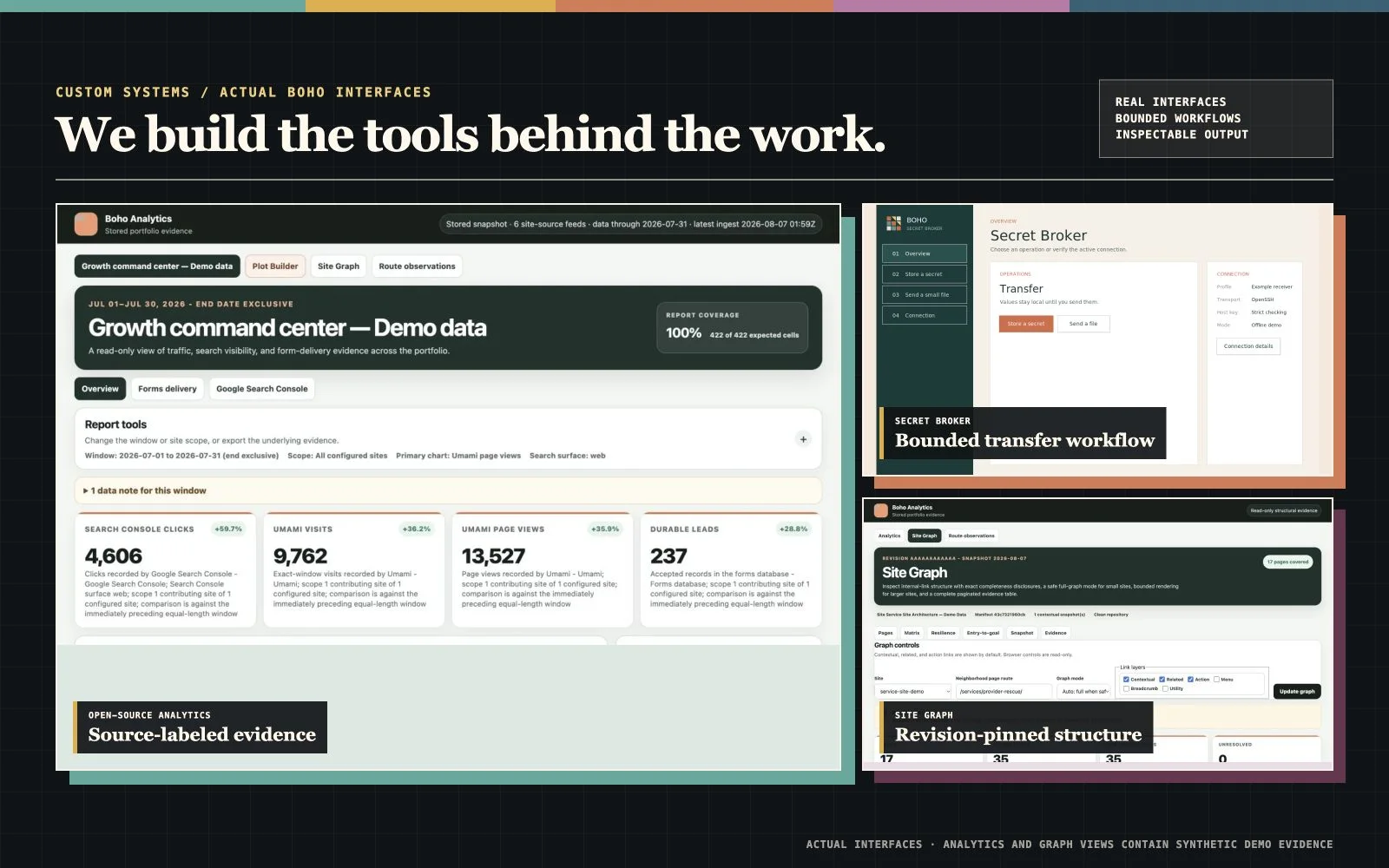
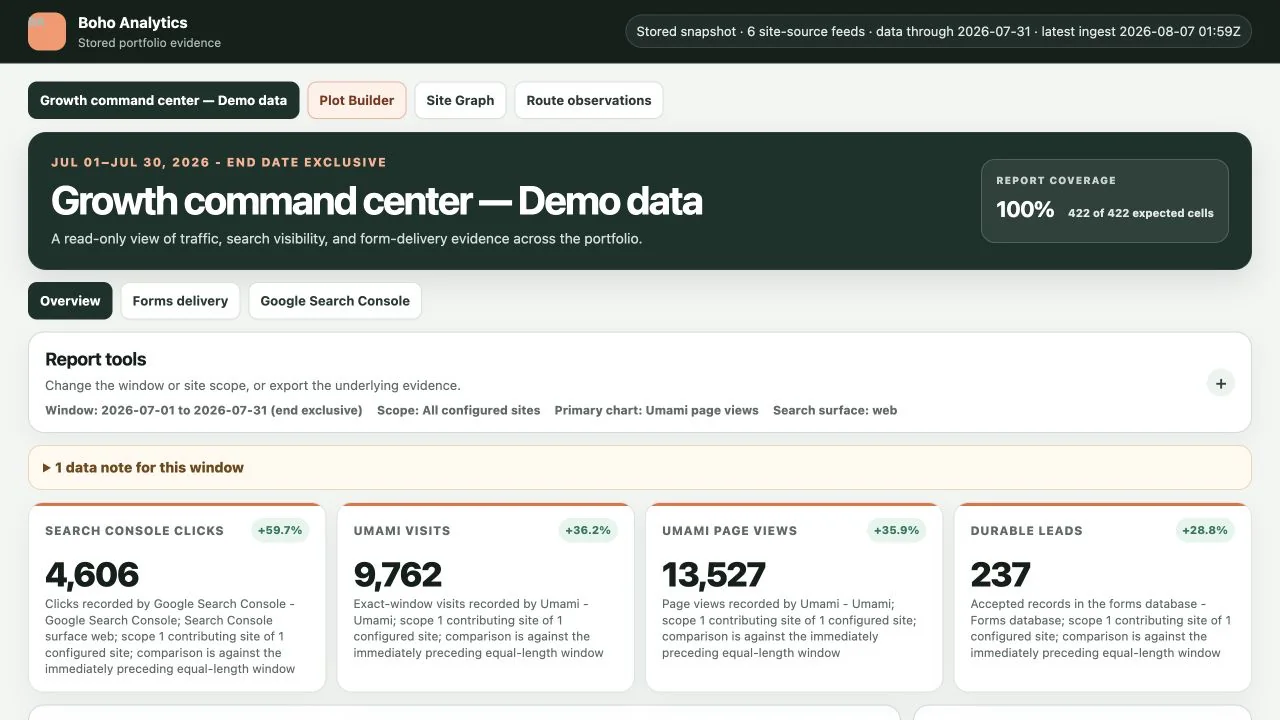
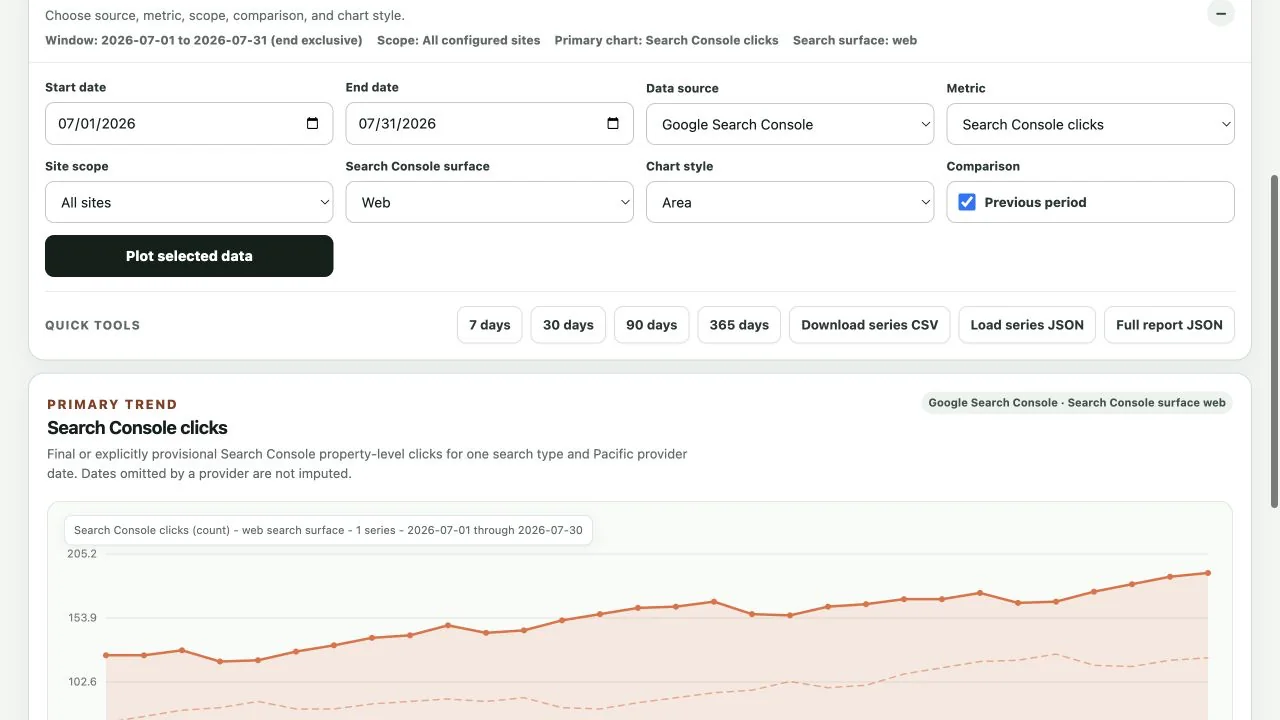
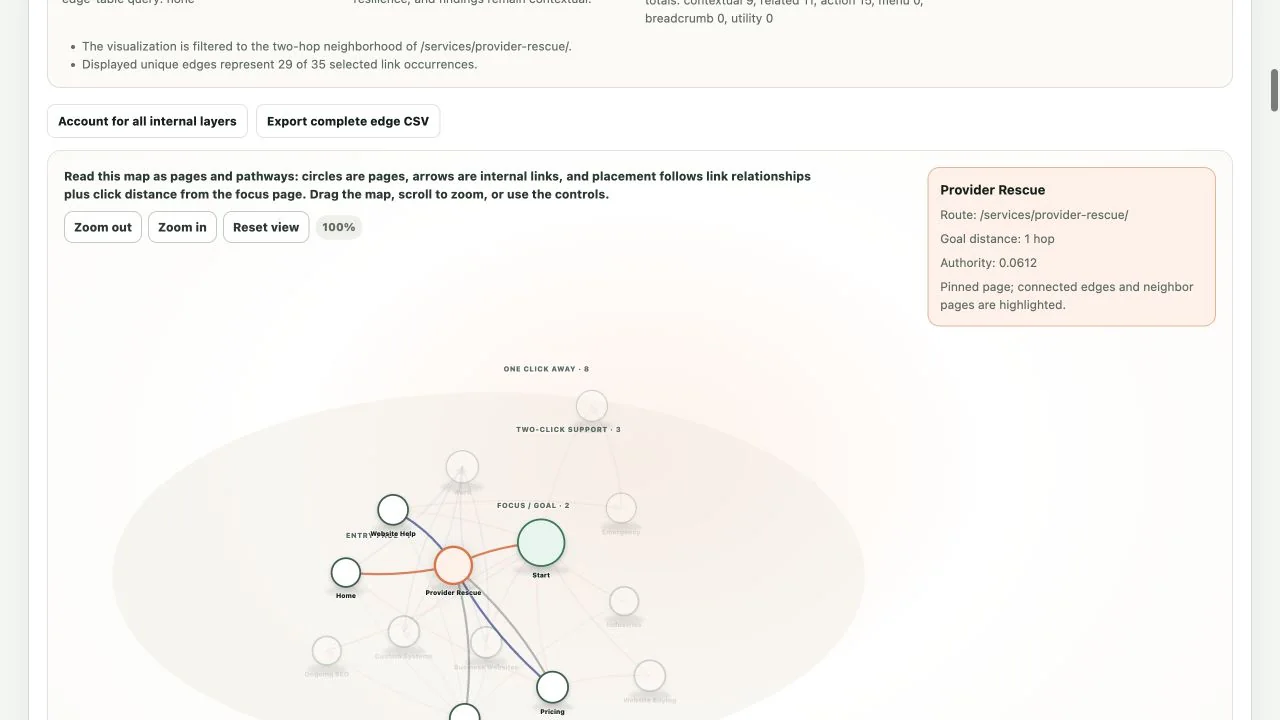
Evidence you can inspect

Relevant public evidence may include:

Public tools demonstrate methods and engineering choices. They do not prove that every custom project will have the same requirements, cost, performance, reliability, or commercial outcome.

Inspect public tools

Questions before scope

Frequently asked questions

Clear boundaries make the next decision easier.

How do I know whether we need a custom build?

Start with the business process. If a stable repeated task has a clear owner, known inputs, defined outputs, meaningful consequences, and a gap that standard products cannot economically solve, custom work may be justified. Discovery can answer that question before a larger build is approved.

What can be built for the $2,500 minimum?

A small, focused tool or simple integration with one primary workflow, limited systems or users, bounded inputs and outputs, standard deployment, testing, and documentation. Larger interfaces, more integrations, sensitive data, complex permissions, high volume, or ongoing support require a different quote.

Is discovery required?

Not always as a separate engagement. A very clear small project may be quotable after the free review and discussion. Discovery is required when the workflow, systems, permissions, data, risks, or correct solution are not yet clear enough for a responsible build quote.

Is the discovery fee credited toward the build?

Yes, when it is eligible, the approved build concerns substantially the same system, the proposal is accepted within 90 days, and the published conditions are met.

Will we own the code?

The proposal states ownership and licensing. Boho generally prefers clear client ownership of project-specific durable assets while retaining ownership or licensing terms for pre-existing tools, reusable methods, open-source components, and third-party services.

Can you integrate with our existing software?

Potentially, after reviewing the provider’s API, authentication, permissions, rate limits, data terms, reliability, costs, and support. A vendor’s marketing claim that an API exists does not guarantee that it supports the required workflow.

Do you build AI automation?

Boho may build approved AI-assisted workflows where the task, data, review boundary, failure risk, provider terms, cost, and human responsibility are clear. Boho does not recommend unreviewed automation for consequential publishing, account changes, sensitive decisions, or claims.

Can you handle sensitive or regulated data?

Only after a specific review of the data, law, contracts, security requirements, providers, permissions, retention, and specialist obligations. Ordinary public pricing does not assume regulated or high-risk data.

Does the build include hosting?

Only when the written scope says so. Custom systems often require separately priced infrastructure, provider usage, monitoring, backups, and maintenance.

What happens when an API or provider changes?

The system may require maintenance or modification. The proposal should state supported dependencies, monitoring, update responsibilities, and whether ongoing support is included.

Can you automate sending, publishing, deleting, or account changes?

Only with explicit , appropriate permissions, logging, error handling, and human-review boundaries. High-consequence actions should not be treated as harmless background automation.

What happens after launch?

Boho provides the agreed documentation and handoff. Maintenance, monitoring, provider administration, support, feature development, and later integrations continue only under a separately approved scope unless already included.