
Research, Analytics & Improvement

Find out what is wrong before paying to fix the wrong thing.

Boho reviews the system, the evidence, and the market to separate visible symptoms from the underlying problem. The result is a prioritized record of what to fix, what to measure, what to leave alone, and what remains uncertain.

Starting price

Focused audit or strategy — Starting at $350Large technical, analytics, market, or multi-property audit: usually 2–4 weeks.Findings discussion: normally offered within two business days after delivery.Several possible projects compete for the same budget.Existing reports provide metrics without a clear decision.The business needs a written priority sequence, limitations, and validation plan.The requester wants a certification, legal opinion, security guarantee, appraisal, or regulated professional conclusion.The required data or access cannot be obtained and no useful public-information scope remains.The desired answer has already been chosen and the review is expected to manufacture support for it.The requested scope cannot be completed responsibly at the available budget.Source and data-quality notesFindings organized by impact, confidence, and difficultyA prioritized action sequenceKnown limitations, dependencies, and unresolved questionsA validation or measurement planA certification, legal opinion, security guarantee, appraisal, or warrantyInvented baselines, estimates presented as observations, or unsupported certaintyUnlimited market, competitor, website, or data-source coverageThird-party data, tools, or specialist review unless stated

Starting prices apply to the smallest complete scope described. Final price depends on the current system, access, content readiness, integrations, third-party dependencies, urgency, risk, and the amount of uncertainty that must be removed before implementation.

Typical planning range

  • Focused review: usually 5–10 business days after the agreed evidence and access are available.
  • Large technical, analytics, market, or multi-property audit: usually 2–4 weeks.
  • Findings discussion: normally offered within two business days after delivery.
  • Several possible projects compete for the same budget.
  • Existing reports provide metrics without a clear decision.
  • The business needs a written priority sequence, limitations, and validation plan.
  • The requester wants a certification, legal opinion, security guarantee, appraisal, or regulated professional conclusion.
  • The required data or access cannot be obtained and no useful public-information scope remains.
  • The desired answer has already been chosen and the review is expected to manufacture support for it.
  • The requested scope cannot be completed responsibly at the available budget.
  • Source and data-quality notes
  • Findings organized by impact, confidence, and difficulty
  • A prioritized action sequence
  • Known limitations, dependencies, and unresolved questions
  • A validation or measurement plan
  • A certification, legal opinion, security guarantee, appraisal, or warranty
  • Invented baselines, estimates presented as observations, or unsupported certainty
  • Unlimited market, competitor, website, or data-source coverage
  • Third-party data, tools, or specialist review unless stated

Timelines are planning ranges, not guarantees. Work begins after the required access, content, approvals, and initial payment are available. Provider delays, platform reviews, missing assets, scope changes, and client response time can extend the calendar.

First useful step

Send the current website or system, the business context, what is happening, and what matters most. Boho will review the visible situation and identify the smallest useful next step. A submitted inquiry is not an accepted project, quote, emergency response, or guarantee of availability.

This is a fit when

  • The business does not know which visible problem is causing the larger failure.

Start somewhere else when

  • The immediate problem is a verified outage or urgent failure requiring bounded emergency triage.

Usually included

  • Scope and evidence definition
  • Large technical, analytics, market, or multi-property audit: usually 2–4 weeks.
  • Findings discussion: normally offered within two business days after delivery.
  • Several possible projects compete for the same budget.
  • Existing reports provide metrics without a clear decision.
  • The business needs a written priority sequence, limitations, and validation plan.
  • The requester wants a certification, legal opinion, security guarantee, appraisal, or regulated professional conclusion.
  • The required data or access cannot be obtained and no useful public-information scope remains.
  • The desired answer has already been chosen and the review is expected to manufacture support for it.
  • The requested scope cannot be completed responsibly at the available budget.
  • Source and data-quality notes
  • Findings organized by impact, confidence, and difficulty
  • A prioritized action sequence
  • Known limitations, dependencies, and unresolved questions
  • A validation or measurement plan
  • A certification, legal opinion, security guarantee, appraisal, or warranty
  • Invented baselines, estimates presented as observations, or unsupported certainty
  • Unlimited market, competitor, website, or data-source coverage
  • Third-party data, tools, or specialist review unless stated

Not included unless the proposal says so

  • Automatic implementation unless the proposal includes it

What Boho needs from you

The business question or decision the work should support

What changes the price

Pricing increases with page and template volume, websites, properties, brands, locations, markets, data sources, customer actions, ecommerce or revenue events, custom grouping, attribution complexity, data damage, provider complexity, research depth, meetings, and manual analyst time.

Example deliverable

Executive summary

An audit is an evidence-based review, not a certification, legal opinion, security guarantee, appraisal, or promise that every hidden defect will be found.

Audits should create decisions.

A useful audit does not merely describe everything a tool can detect. It explains what appears weak, why it may matter, what evidence supports the concern, how confident the conclusion is, what the fix would require, and what should happen first.

Technical warnings, weak , poor review signals, missing , provider-access problems, and unclear customer paths may all deserve attention. They are not automatically equal problems.

The work is to rank them intelligently.

Common research and audit packages

Focused Decision Review

A narrow review of one defined question, system, or customer path.

Examples:

  • Why are not reaching the business?
  • Does the current website need repair or redesign?
  • Which service page deserves attention first?
  • Is the current provider’s visible work understandable and useful?
  • Is measurement good enough to support a larger investment?

Audit

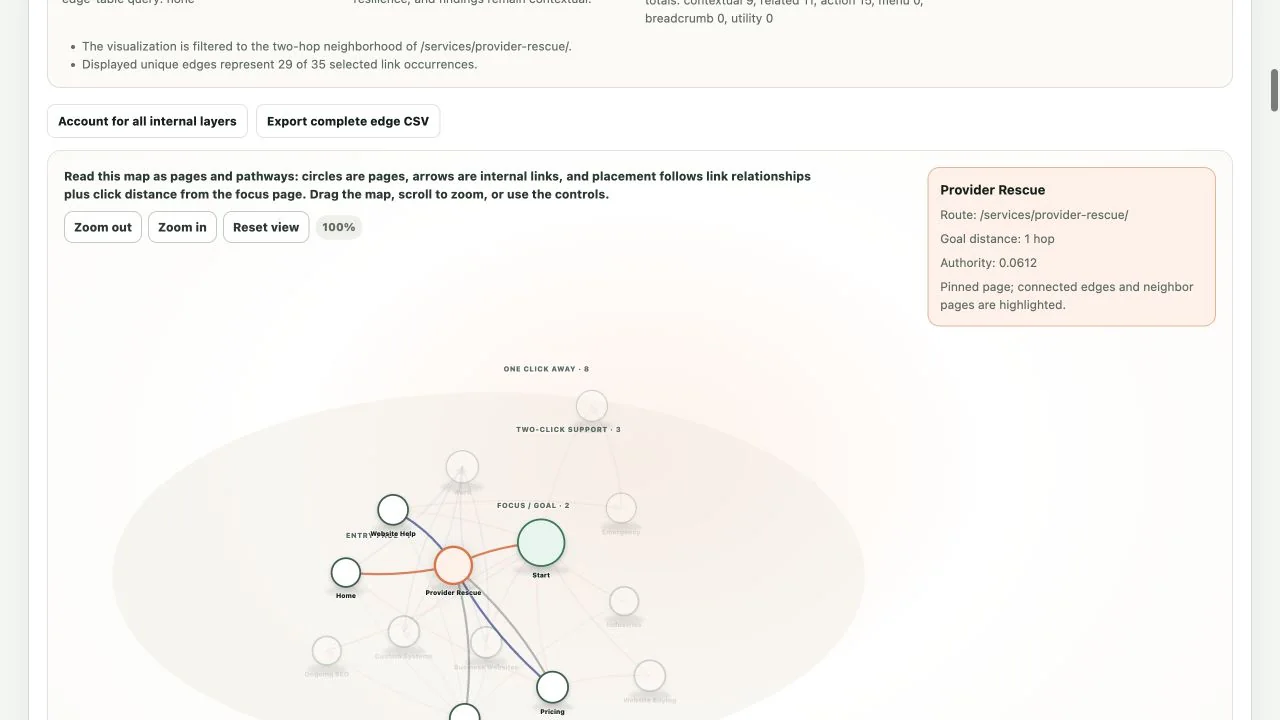
A prioritized review of the technical conditions that affect whether important pages can be crawled, indexed, understood, used, measured, and maintained.

The review may include:

  • Crawl access
  • Indexation signals
  • signals
  • Duplicate and orphaned paths
  • Internal linking
  • and headings
  • Structured information
  • Performance and mobile behavior
  • Migration risks
  • Analytics and search-property access

Local Market and Competitor Report

A study of the visible local market, including competitor websites, business profiles, reviews, service areas, result types, customer paths, website quality, and possible gaps.

The report should distinguish observed public facts from hypotheses. It should not pretend that public competitor data reveals private revenue, lead volume, rates, or strategy.

Analytics and Measurement Readiness Review

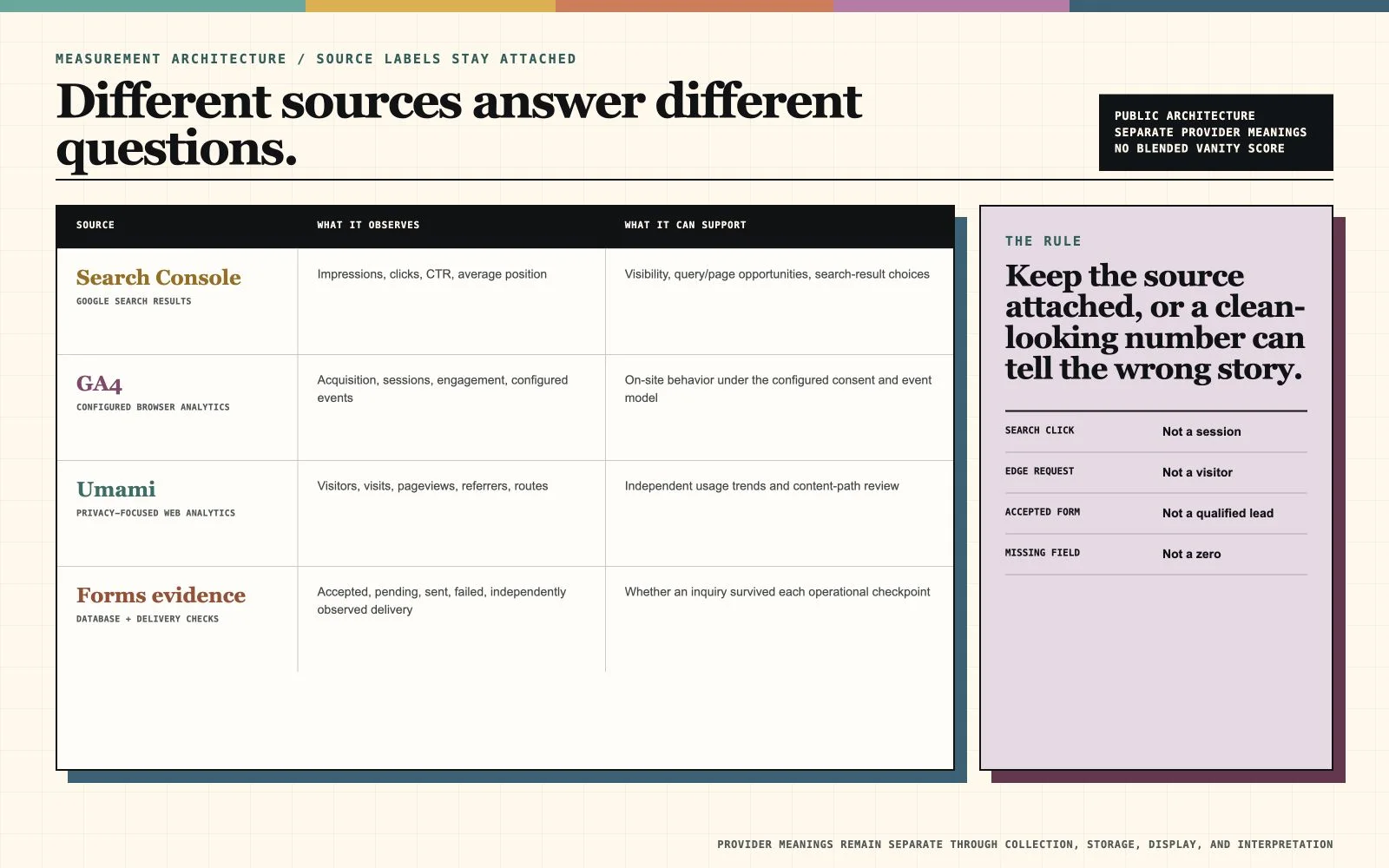
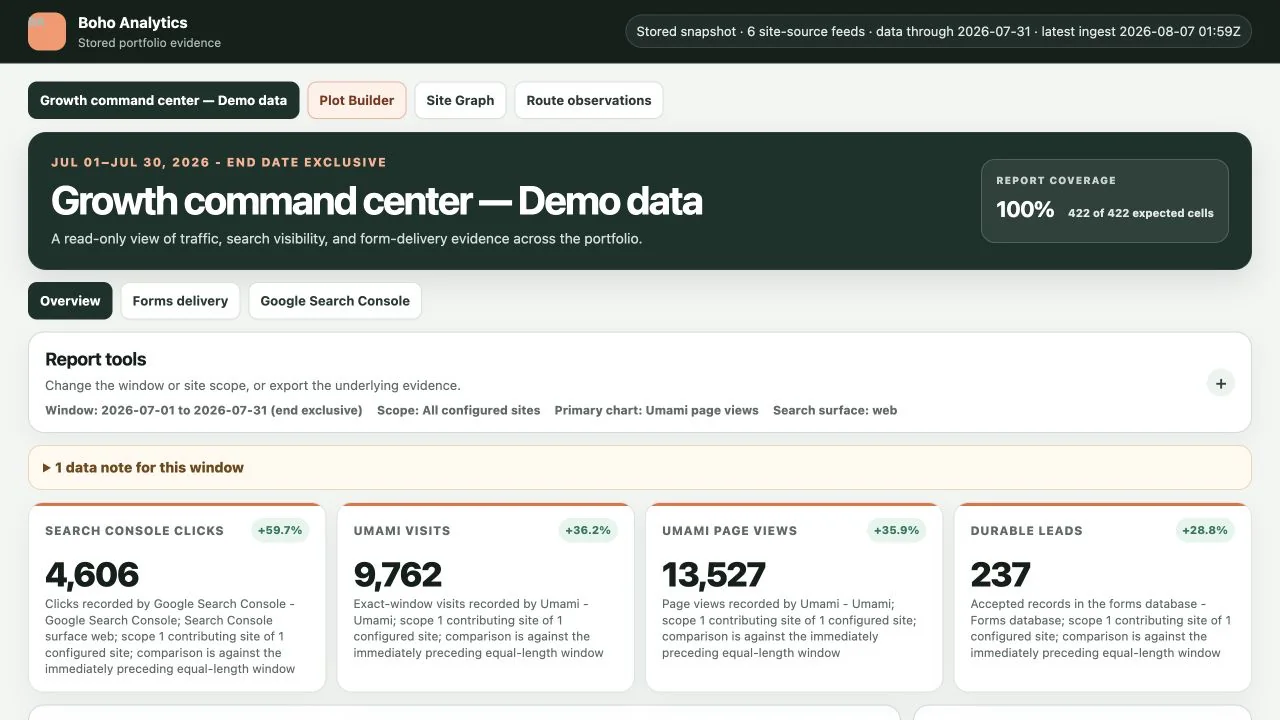
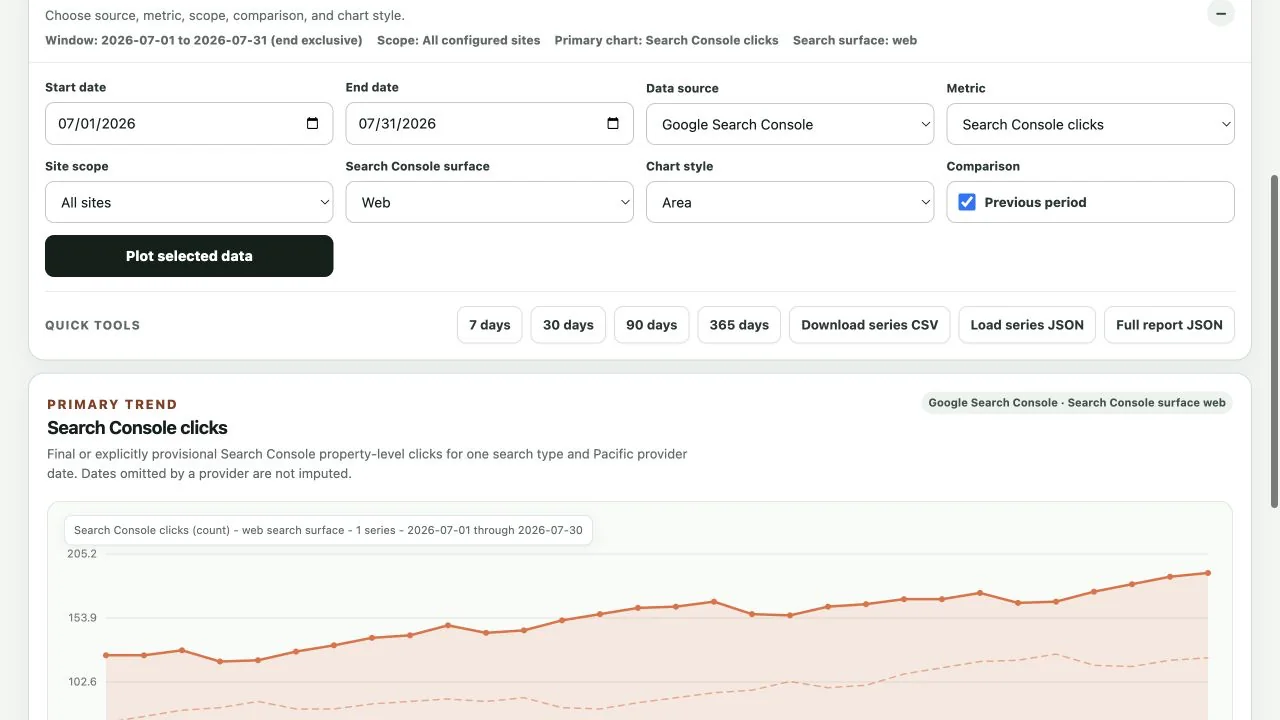
A review of what is collected, what is missing, whether important actions are defined, how sources disagree, which reports are useful, and what must be configured before reliable conclusions can be made.

When usable historical data does not exist, the deliverable is a Measurement Readiness Report rather than a fabricated .

Provider Performance or Second-Opinion Review

A review of supplied reports, visible website changes, access, ownership, deliverables, technical conditions, and whether the current provider’s work can be connected to a clear purpose.

Boho does not make legal conclusions about a provider contract or claim misconduct without evidence. The review is intended to clarify the work and the next business decision.

Migration Risk Review

A review of domains, , content, , analytics, , , email dependencies, , access, and other conditions that could affect a redesign or move.

What Boho may study

Business and market context

  • Business model
  • Most valuable services or products
  • Intended customers
  • Markets and locations
  • Seasonality
  • Customer decision process
  • Operational capacity
  • Known constraints

Website and content

  • Offer clarity
  • Page architecture
  • Service, category, product, or location structure
  • Content quality and duplication
  • Trust and proof
  • Forms and confirmation behavior
  • Mobile and accessibility conditions

Search and local visibility

  • Search-result presence
  • Query and page patterns where supported
  • Crawl and indexation
  • Business-profile alignment
  • Local market signals
  • Competitor page and result structures
  • Service and location relevance
  • Technical search risks

Measurement

  • Analytics properties
  • Business-profile information
  • Form and customer-action events
  • Ecommerce or revenue events where authorized
  • Data freshness
  • Filters and exclusions
  • Source disagreement
  • Missing data
  • Collection failures

Providers, ownership, and migration

  • Domains
  • DNS
  • Hosting
  • Website platform
  • Administrative access
  • Analytics and search properties
  • Forms
  • Email dependencies
  • Third-party integrations
  • Provider responsibilities
  • Exit and migration risks

The Boho report standard

Every substantial report should make the research process inspectable.

Start with a data receipt

The report should identify:

  • Reporting or review period
  • Websites, properties, markets, or systems reviewed
  • Sources used
  • Last successful collection or review date
  • Missing, stale, unavailable, or failed sources
  • Relevant filters and exclusions
  • Methodology version
  • Analyst review date
  • Material assumptions

Separate three kinds of statements

Observed means directly supported by the reviewed evidence.

Inferred means a reasonable interpretation that still contains uncertainty.

Recommended means an action proposed on the basis of the evidence, business context, risk, cost, and stated assumptions.

These labels should not be collapsed into one paragraph of artificial confidence.

Use a consistent finding format

A material finding should identify:

  • The issue or signal
  • The evidence
  • Why it may matter
  • Confidence and limitations
  • Recommended action
  • Priority
  • Estimated effort or difficulty
  • Responsible owner
  • Validation signal
  • Review date

Apply quality gates

A report should disclose or stop when:

  • A required source failed
  • A source is materially stale
  • Date ranges do not match
  • Conversion definitions changed
  • Totals disagree beyond an accepted threshold
  • There is insufficient evidence for the requested conclusion
  • A recommendation lacks a supporting reason

Limit the main decision set

The main report should usually lead with three to five priority actions, one section identifying what should not be purchased yet, and a validation plan. Broader data can remain available in an appendix or underlying system.

What you receive

Depending on the scope, deliverables may include:

  • Executive summary
  • Defined research question
  • Business and market context
  • Source and data receipt
  • Known limitations
  • Success signals and valuable actions
  • Findings by category
  • Competitor or market comparison
  • Technical issue list
  • Customer-path review
  • Provider or ownership findings
  • Priority model
  • Recommended sequence
  • Measurement plan
  • Risks and dependencies
  • Optional implementation scope
  • Supporting tables, maps, or appendices
  • Measurement Readiness Report when valid baseline data does not exist

What Boho needs from the client

The client may need to provide:

  • The business question or decision the work should support
  • Website, market, service, product, location, and customer-action context
  • Authorized access to relevant data sources
  • Existing reports, audits, proposals, contracts, or provider records
  • Accurate definitions of qualified inquiries, purchases, or other valuable outcomes
  • Known data-quality problems
  • Relevant business constraints and budget
  • A responsible person who can answer questions and approve access
  • Legal or professional review for regulated data or claims

Boho should collect only the information reasonably necessary for the approved analysis. Passwords, private keys, payment data, and sensitive personal records should not be sent through ordinary forms or email.

Pricing

Initial public review: Free

Analyst-reviewed monthly report: Starting at $95 per month

Standalone review, audit, or research project: Starting at $350

The $95 starting report is intended for one small website, one primary reporting property, a limited number of supported sources, one simple customer-action path, data-quality status, three priority findings, and a written report without implementation or a standing meeting.

The $350 starting one-time review applies to one narrow question, a small public system, limited access, and a defined written recommendation.

Pricing increases with page and template volume, websites, properties, brands, locations, markets, data sources, , ecommerce or revenue events, custom grouping, attribution complexity, data damage, provider complexity, research depth, meetings, and manual analyst time.

See monthly reporting prices

See audit and strategy prices

Assessment credit

When an eligible paid review, audit, or assessment leads to a qualifying larger implementation engagement in the same category, Boho credits 100% of the eligible one-time fee toward the larger engagement, subject to the published credit conditions.

The credit normally requires full payment, substantially the same business and system, acceptance within 90 days, and research that remains materially usable. It has no cash value and does not apply to recurring reports already delivered, , third-party costs, priority premiums, or unrelated work.

Pricing notice

Public prices are general planning guidance in U.S. dollars, not quotes, binding offers, warranties, or commitments. Starting prices apply only to the smallest complete scope described. Final scope, price, timing, deliverables, exclusions, dependencies, ownership, support, service levels, and third-party costs are determined only through a specific written engagement.

What is not included unless the proposal says otherwise

  • Website or implementation
  • Custom tracking setup
  • Historical-data reconstruction
  • Unlimited data sources
  • Unlimited properties, markets, or competitors
  • Legal, tax, financial, medical, security, or compliance opinions
  • Private competitor data
  • Guaranteed rankings, traffic, leads, sales, or revenue
  • Paid data, software, or provider charges
  • Advertising management
  • Ongoing content production
  • Provider recovery or migration execution
  • Unlimited meetings or consulting
  • Emergency or priority work

Questions before scope

Frequently asked questions

Clear boundaries make the next decision easier.

Is the initial review really free?

Yes. It uses public information to identify the likely next step. It is not a complete audit, private-account review, written strategy, provider recovery, or implementation project.

Yes. The public is open source and available to self-host for supported uses and data sources. Custom setup, tracking repair, historic reconstruction, private integrations, complex ecommerce configuration, or unsupported data work may require a paid scope.

What am I paying for in the monthly report?

An analyst checks the available data, explains what it shows, lists the most important findings, notes its limits, and provides written next steps. You are paying for the analysis, not for access to software.

Why does reporting cost more for ecommerce or large websites?

Checkout events, revenue, catalogs, many templates, multiple properties, cross- journeys, conflicting platforms, custom groupings, and damaged tracking require more collection review, reconciliation, interpretation, and risk control than one small website with a simple form path.

Does a report include implementation?

No, unless the written scope says otherwise. Reporting-only plans provide analysis and recommendations. Website changes, SEO work, tracking repair, content, migration, and other implementation are separate.

Do you guarantee that an audit will improve rankings or revenue?

No. An audit can identify evidence, risk, priorities, and recommended actions. Outcomes depend on implementation, market conditions, platforms, competitors, customers, time, and the business itself.

What happens if the data is bad or missing?

The report should say so. Boho may provide a Measurement Readiness Report explaining what is missing, what should be configured, what can currently be concluded, and what cannot.

Can you review another provider’s reports?

Yes, when the client is authorized to share them. Boho can evaluate whether the reports identify sources, work completed, evidence, limitations, priorities, and useful next actions. The review is not a legal opinion about the provider contract or conduct.

Can a paid audit be credited toward implementation?

Yes, when it is an eligible one-time review and the qualifying larger engagement falls within the same category, concerns substantially the same system, is accepted within 90 days, and meets the published conditions.

How many competitors do you review?

The number depends on the research question, market, data quality, and written scope. A useful sample is better than a large list assembled without a decision in mind.

Can you analyze payment or ecommerce information?

Boho may review approved aggregate analytics, product, order, and conversion information where appropriate. Boho does not need or request card numbers, banking credentials, secrets, or raw payment details for ordinary reporting.

Will the report tell us what not to buy?

It should. A useful report identifies low-priority work, unsupported ideas, missing prerequisites, and spending that should wait until better evidence exists.